Hot For Horseradish

This is a love story about all things hot.  Not hot like the sun, but hot to your taste.  We love foods that have a little heat to them here on Glen Road.  In fact, we are always taking recipes and putting a little heat into them.  We add cherry peppers into broccoli rabe, we put cayenne pepper into almost anything and there is nothing better than cold clams with tabasco sauce, to name a few.  However, our favorite is freshly roasted beef or a polish sausage with a little side of homemade horseradish.  Funny thing is, we don’t have any horseradish that grows in our garden.  When we want horseradish, we need to buy the root at our local organic produce market.  Well, this is about to change because we have planted a bed of five horseradish roots.  The five little brown stalks appear to be so innocent, but in a year they will produce thick roots that are filled with fire.  These roots were planted down from our newly planted rhubarb patch, right behind the espalier apple trees.  Let’s get the heat started with a little horseradish history from the internet:

Horseradish (Armoracia rusticana) is in the brassica family, which includes turnips, kale, mustard greens, broccoli rabe, daikon radish and many other plants with varying degrees of pungency and a similar taste.  Native to the temperate regions of Europe and Asia, it is an ancient herb.  The Romans carried horseradish to Europe as a medicinal herb and as a flavoring.  It was cultivated in Egypt before the exodus of the Hebrew slaves around 1500 B.C., and is often the symbolic bitter herb at the Passover Seder.

By the 16th century, the pungent root was spreading throughout England, where it was described for  its many uses, including as an aphrodisiac, a treatment for tuberculosis, a mustard plaster and a dewormer.  The common name probably evolved from the German “meerrettich,” which means sea-radish, which was misunderstood by the English, who associated “meer” with “mahre,” an old horse.
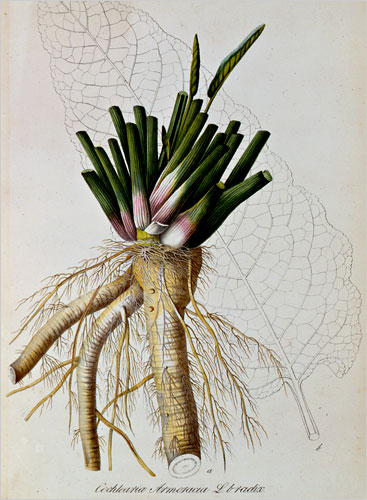
Undisturbed, the root doesn’t have a strong smell or flavor. But crushing or grinding it produces isothiocyanates, a kind of mustard oil, which is what gives horseradish its flavor and heat.  Adding vinegar stops the reaction because it’s an acid.  It also stabilizes the isothiocyanates, so you can still get that flavor a week later.  Tradition calls for grinding the root outside, because the chemical reaction triggered creates a gas that not only makes you weep, but can irritate lungs and nostrils.  This is actually a defense mechanism for the plant if it’s wounded.

We planted our horseradish in a long furrow about six inches deep.  Each root has a top and a bottom identified by the slicing made by the grower.  The top is identified by a straight slice and the bottom is identified by a diagonal slice.  When we placed them in the furrow, we put them in at an angle, with the straight sliced top pointing upwards.  Once in place, we covered the top of the roots with about four inches of soil, pressed the soil into place and watered.  While we won’t harvest any horseradish this year, the roots will produce beautiful green leaves that will make a nice complement to the equally as beautiful rhubarb leaves that we previously planted along the back side of the espaliers.  Next year, we will harvest and grind a few of the roots, add some white vinegar and salt and begin to enjoy some heat.  As my Grandmother used to say, we can only harvest the roots in months that contain an ‘R’ in them.  Months that don’t contain an ‘R’ are too hot and the root will not produce optimal flavor.
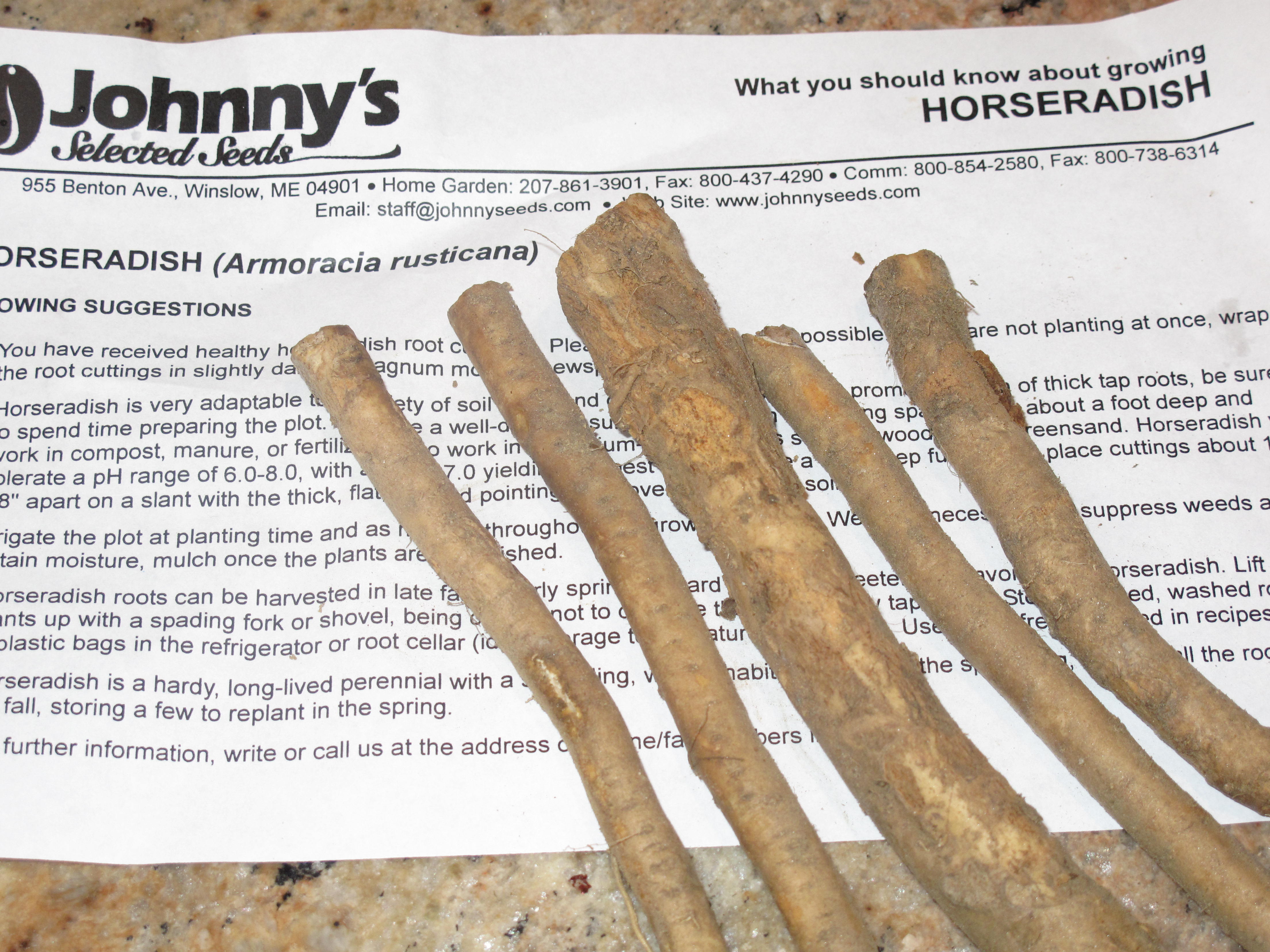
So here’s to horseradish, named “Herb of the Year 2011” by the International Herb Association.  We will look forward to your pretty leaves this year and then the addition of your hotness to our meats, mashed potatoes and seafood in 2012.  We can’t wait.  What hot foods do you and your family like to cook or eat?

Grace Kelly Moves To Glen Road

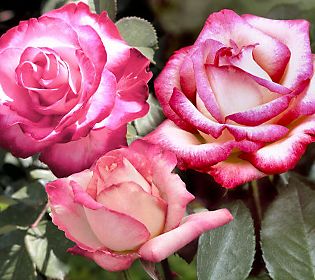
This is Grace Kelly.  As you can see, it is not the actress/princess that you were thinking.  ‘Grace Kelly’ is a variety of tree rose that we planted in a container this weekend so it can begin growing in time to bloom this Summer.  We have had tree roses on the patio almost every year we have lived here on Glen Road.  They have always grown quickly from the dormant tree that we get shipped to us. 

In early Summer, the tree rose begins to bloom and if you are diligent about removing the spent roses, the tree will continue blooming up until the end of the season.  Tree roses are not actually a class of rose, but rather a way of growing them.  A bush or climbing rose is simply grafted onto a straight trunk, giving the desired appearance.  Here is the rose bush that is at the top of the tree we purchased.

Very similar in appearance to a rose bush that you would buy at a nursery, except it is attached to the top of a long trunk.  The roots are about five inches long and we have always just filled a container with organic potting soil and put the tree rose into the soil so that it is covered up to the base of the trunk.  They require very little care other than providing about an inch of water per week and fertilizer every so often.

At the beginning of June, our tree roses have always produced an array of beautiful, full-sized rose buds.  The variety ‘Grace Kelly’ appears as beautiful as the woman it is named after.  Pale pink roses tipped in a dark pink to red.  Here are some pictures of our desired end state.  Grow, girl, grow!

So now Glen Road has had its first celebrity (er, celebrity tree rose) come visit in 2011.  Again, we have always planted these beautiful plants every year on Glen Road.  Since they are a perennial, you can also winter them and bring them back year after year.  To winter in mild zones, you need only wrap in-ground plants in straw or burlap.  To winter in northern zones, you must bend the plants without breaking its roots and cover with soil.  Containerized plants can be moved to an unheated, protected area.  Give a tree rose a try to brighten up your patio this Summer.  They are readily available on the internet and aren’t that expensive.  When’s the last time a princess stayed in your backyard?  Tell us what plants you are planting on your patio and deck this season?

When Rhubarb And Strawberries Unite

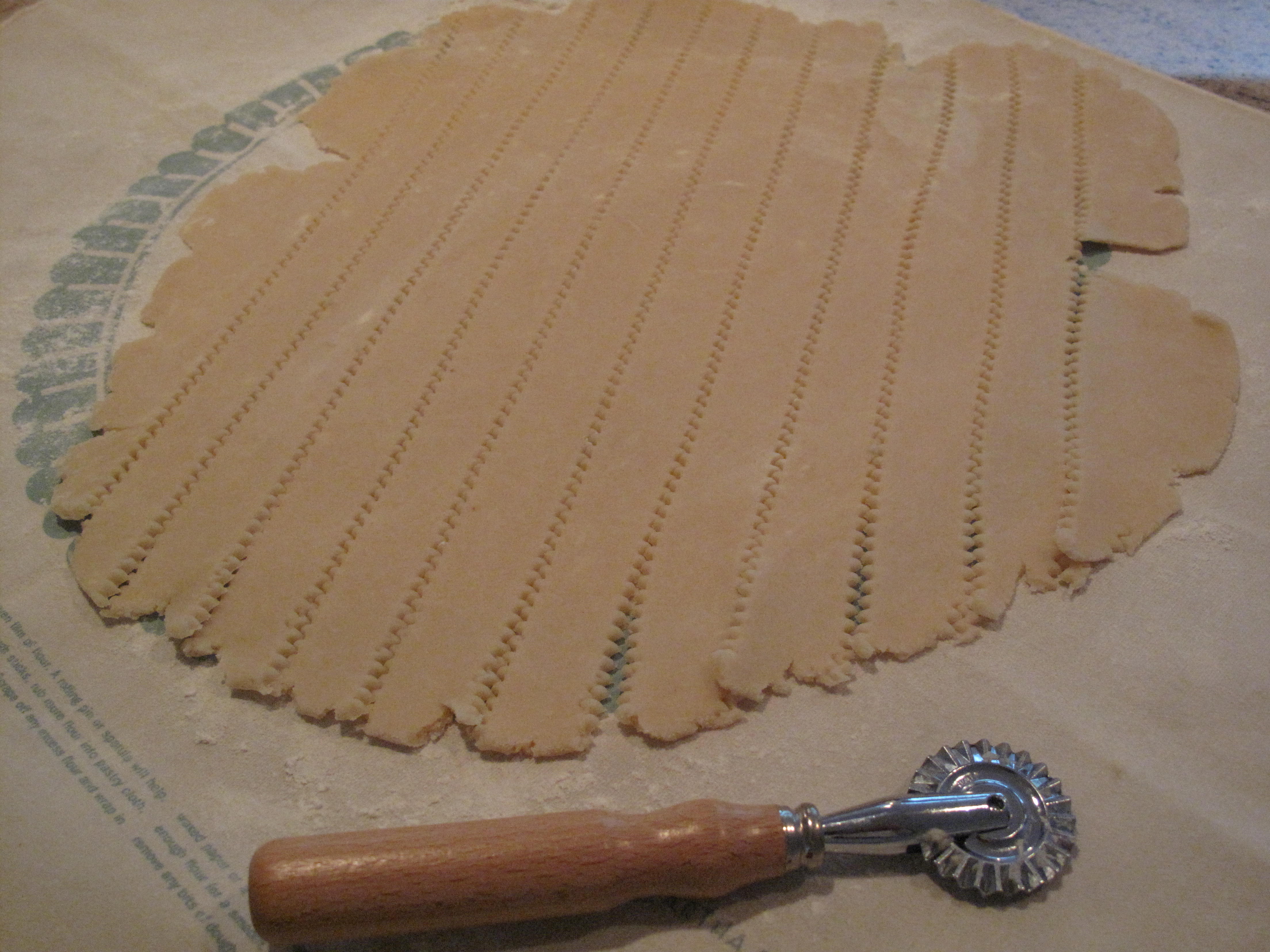
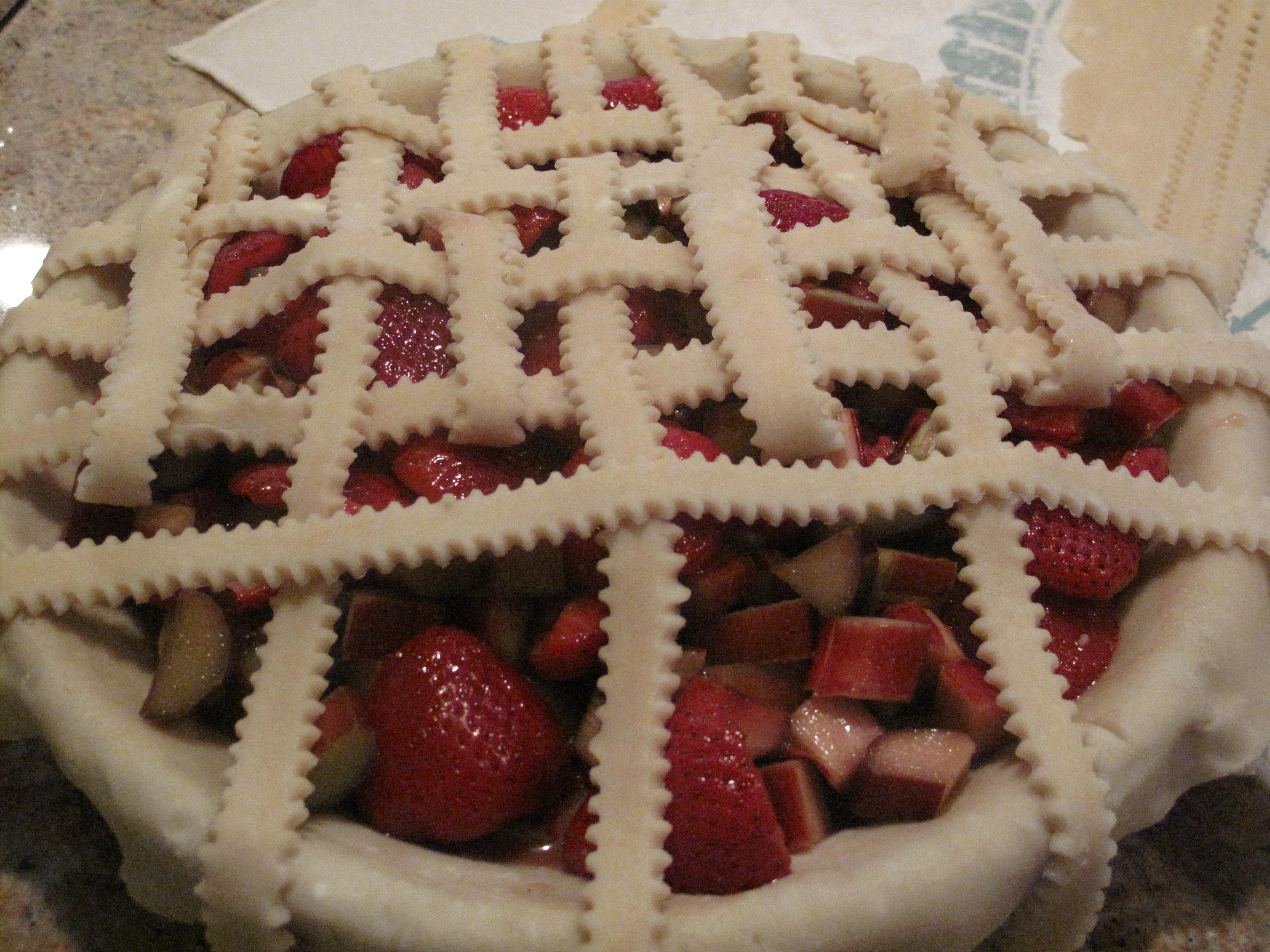
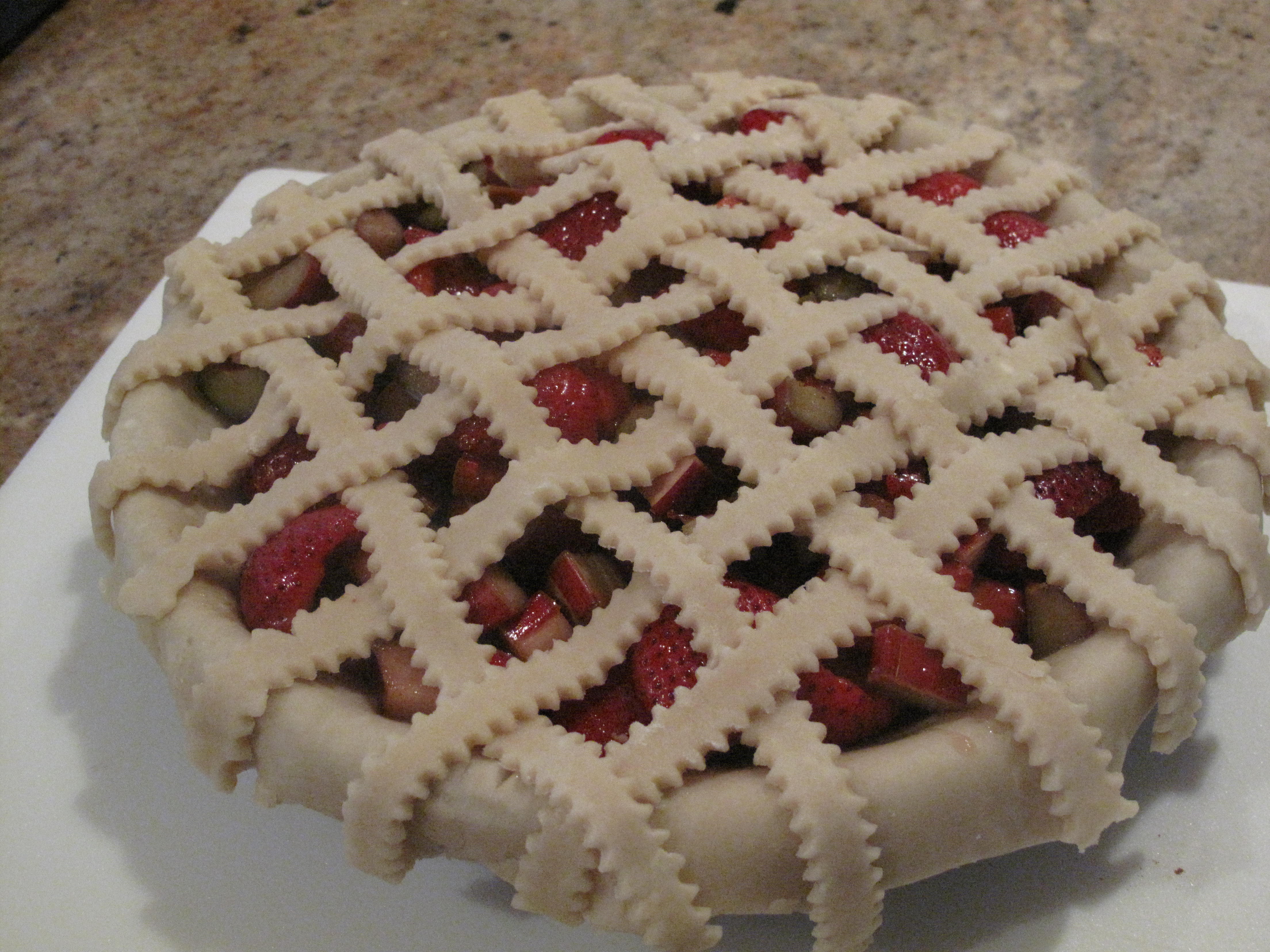
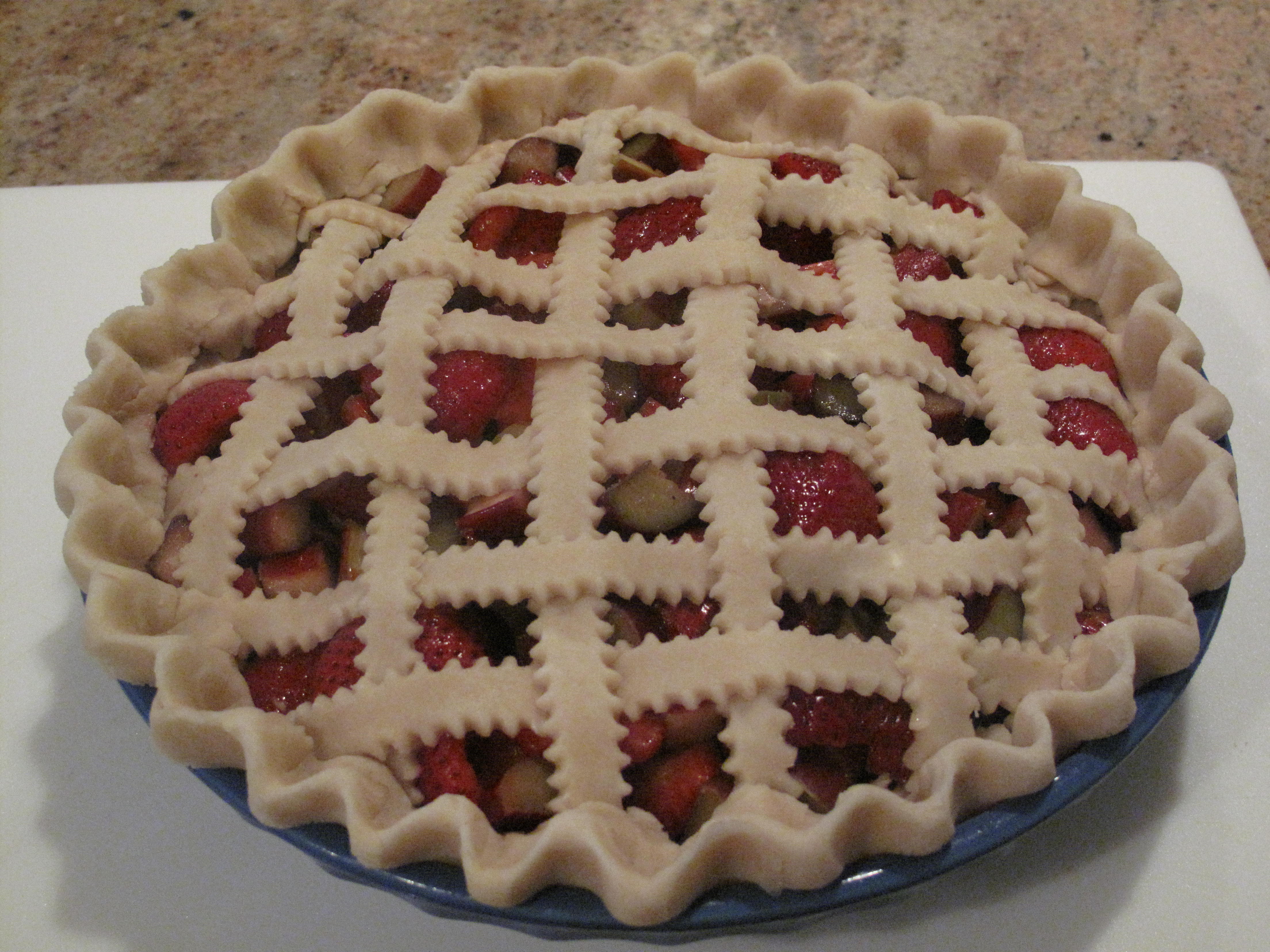
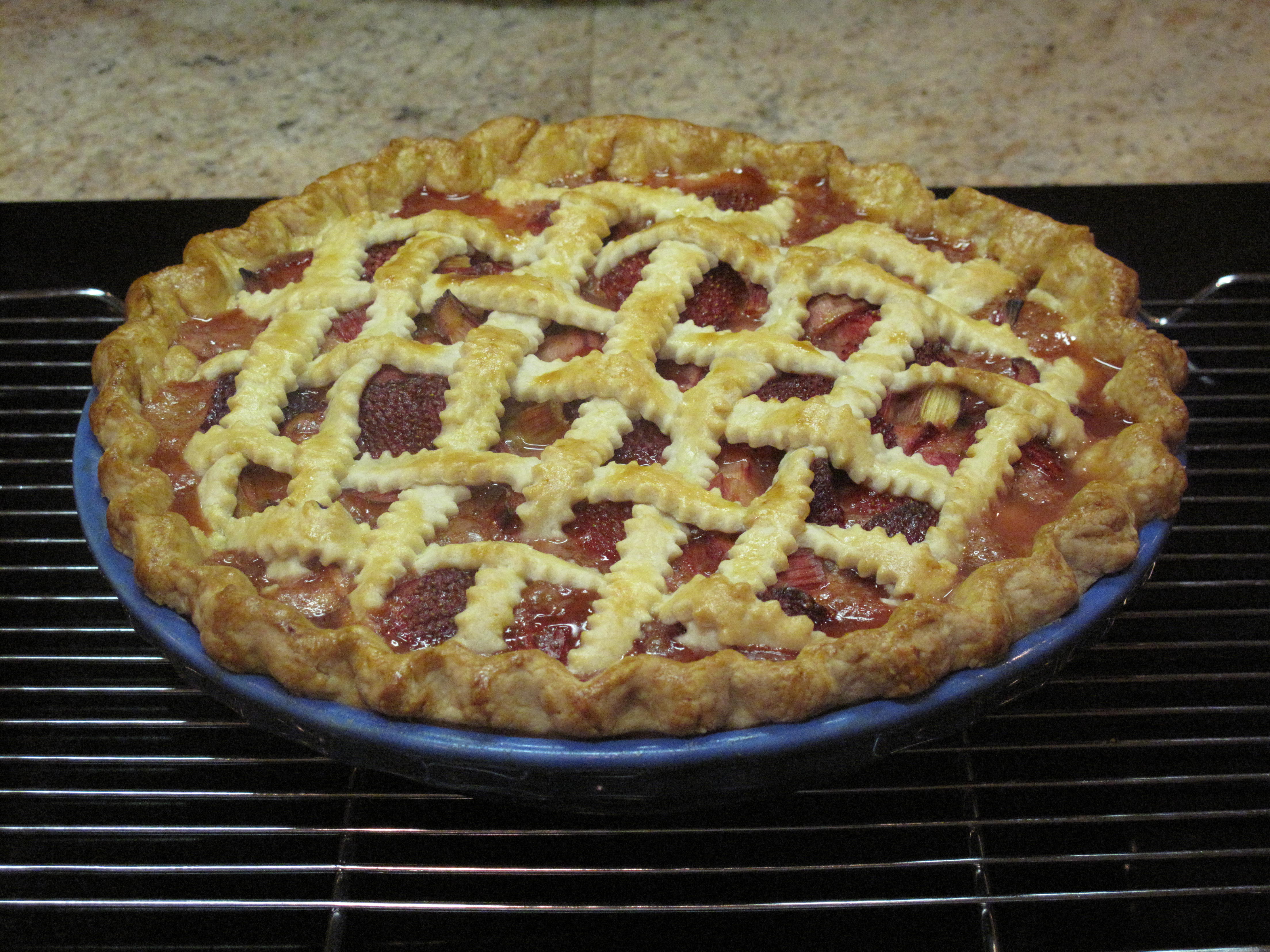
 This pie always reminds me of Spring.  It is a rhubarb and strawberry pie with a lattice top crust.  Making a pie is always intimidating to me.  It’s the crust.  Either I have a problem rolling it out or I have a problem getting it into the pie pan.  A lot of people tell me they have the same issues, but I keep trying to perfect the art of pie making here on Glen Road.  This pie was a surprise in that for the first time in a long time I didn’t have any issues.  I even put a lattice top on it without making myself nuts.  It must have been the deep breaths and the frequent praying.  The idea of rhubarb and strawberries mixed together in this pie was so perfect for Spring.  I couldn’t wait to get a piece.  We’ve talked about rhubarb and strawberries a lot here on Acorns On Glen.  Spring just seemed the perfect time to mix them together for everyone to enjoy.  Let’s get baking!

 Ingredients:

For crust:
3 cups all-purpose flour
2 1/2 teaspoons sugar
3/4 teaspoon salt
2/3 cup chilled solid vegetable shortening, cut into pieces
1/2 cup plus 2 tablespoons (1 1/4 sticks) chilled unsalted butter, cut into pieces
Up to 10 tablespoons ice water
For filling:
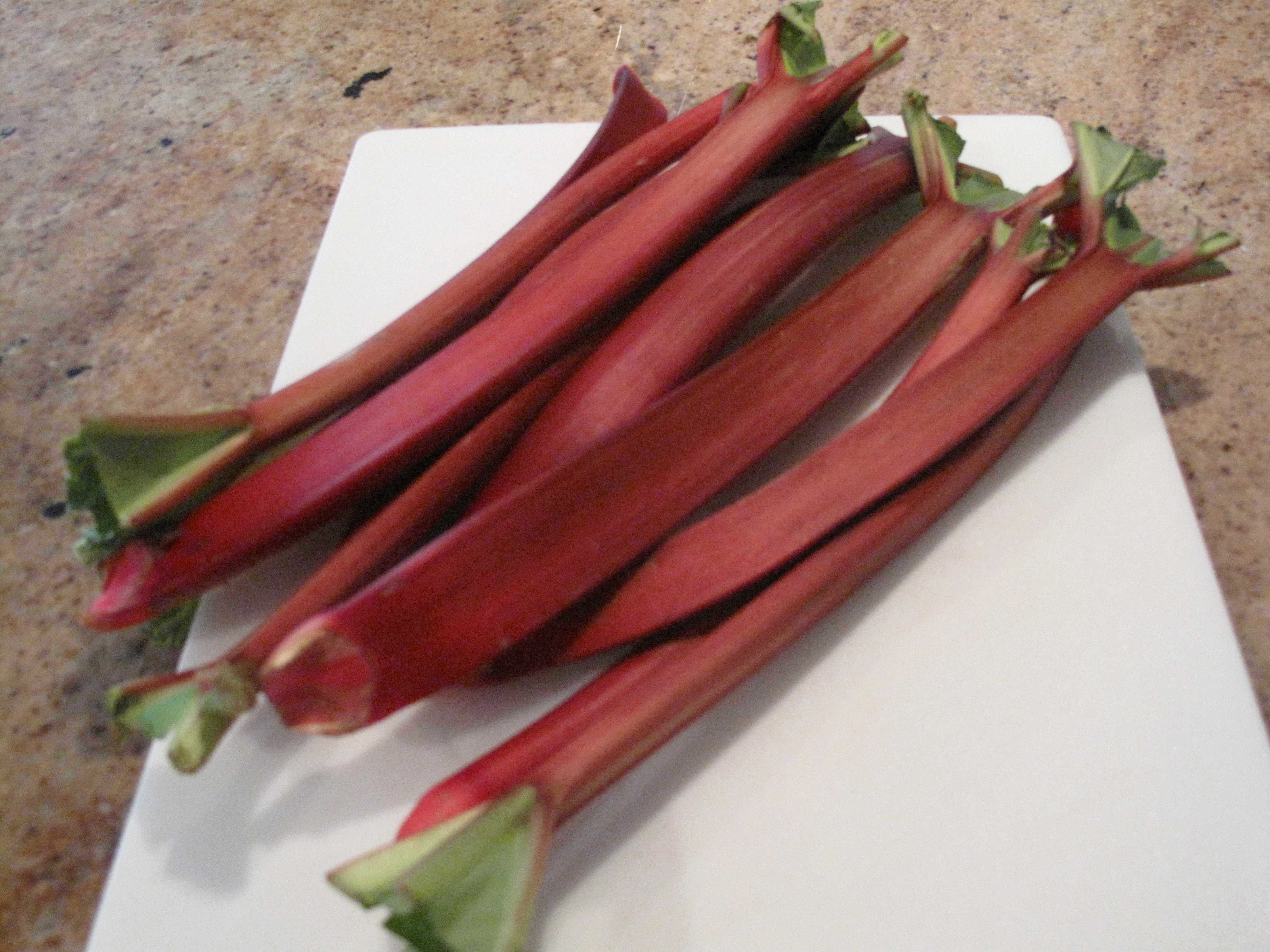
3 1/2 cups 1/2-inch-thick slices of trimmed rhubarb (1 1/2 pounds untrimmed)
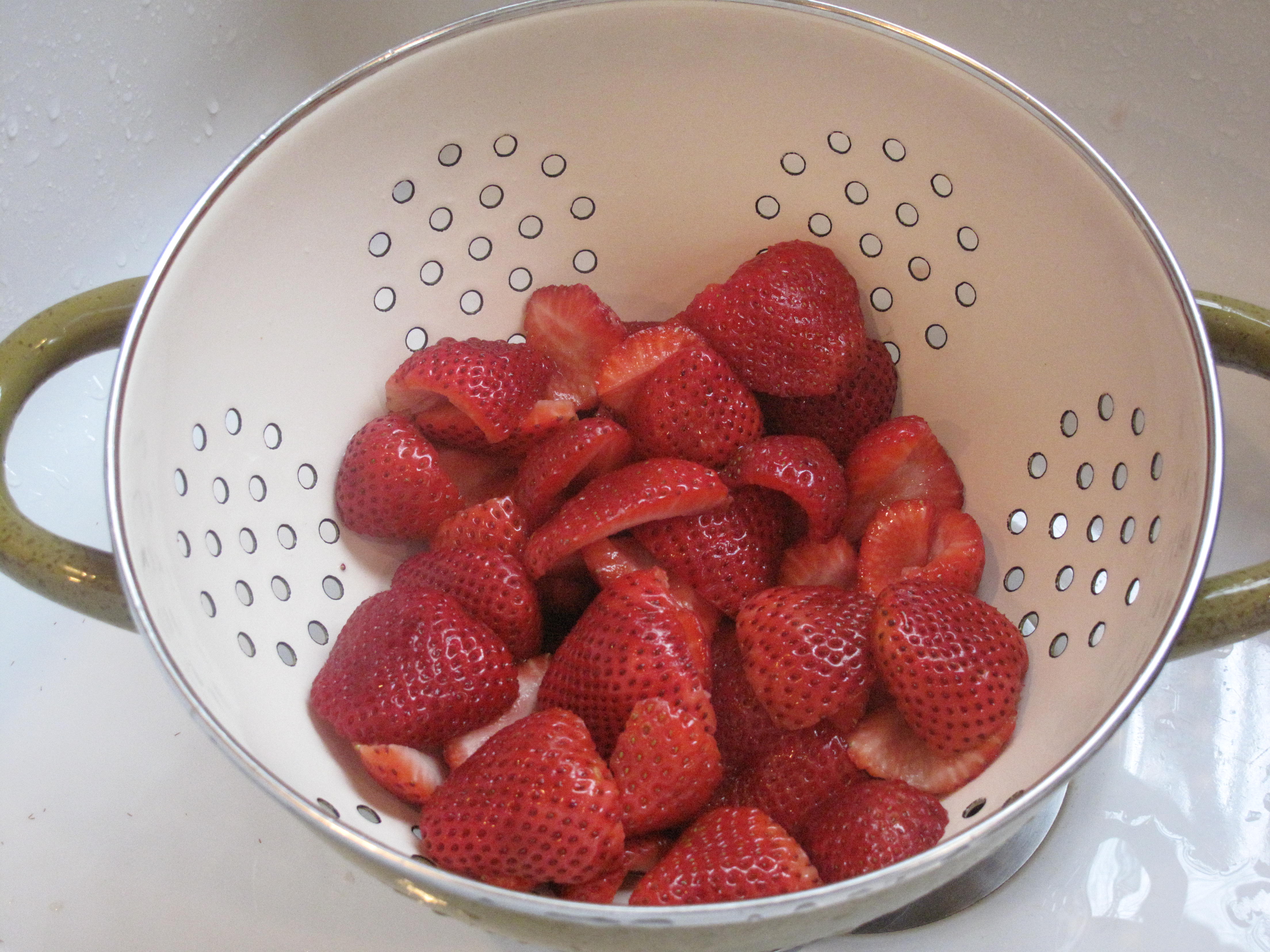
1 16-ounce container strawberries, hulled and halved (about 3 1/2 cups)
1/2 cup packed golden brown sugar
1/2 cup sugar
1/4 cup cornstarch
1 teaspoon ground cinnamon
1/4 teaspoon salt
1 large egg yolk beaten to blend with 1 teaspoon water (for glaze)

Directions:

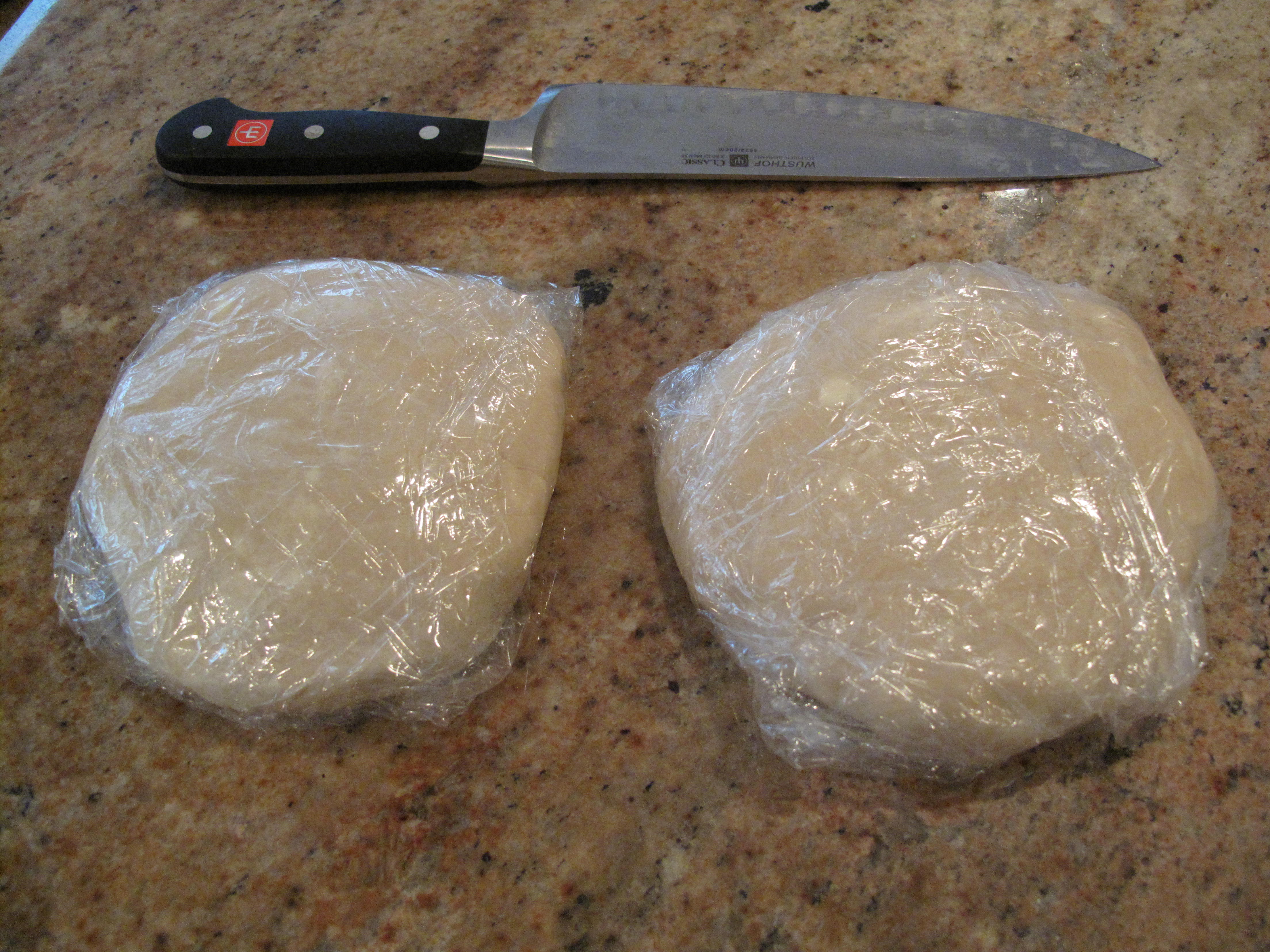
Make crust:  Combine flour, sugar and salt into a food processor.  Using the pulse button, cut in shortening and butter into the flour mixture until coarse meal forms.  Blend in enough ice water (2 tablespoons at a time) to form moist clumps.  Gather dough into a ball; cut in half.  Flatten each half into a disk.  Wrap separately in plastic; refrigerate until firm, about 1 hour (can be made 1 day ahead. Keep chilled. Let dough soften slightly at room temperature before rolling).

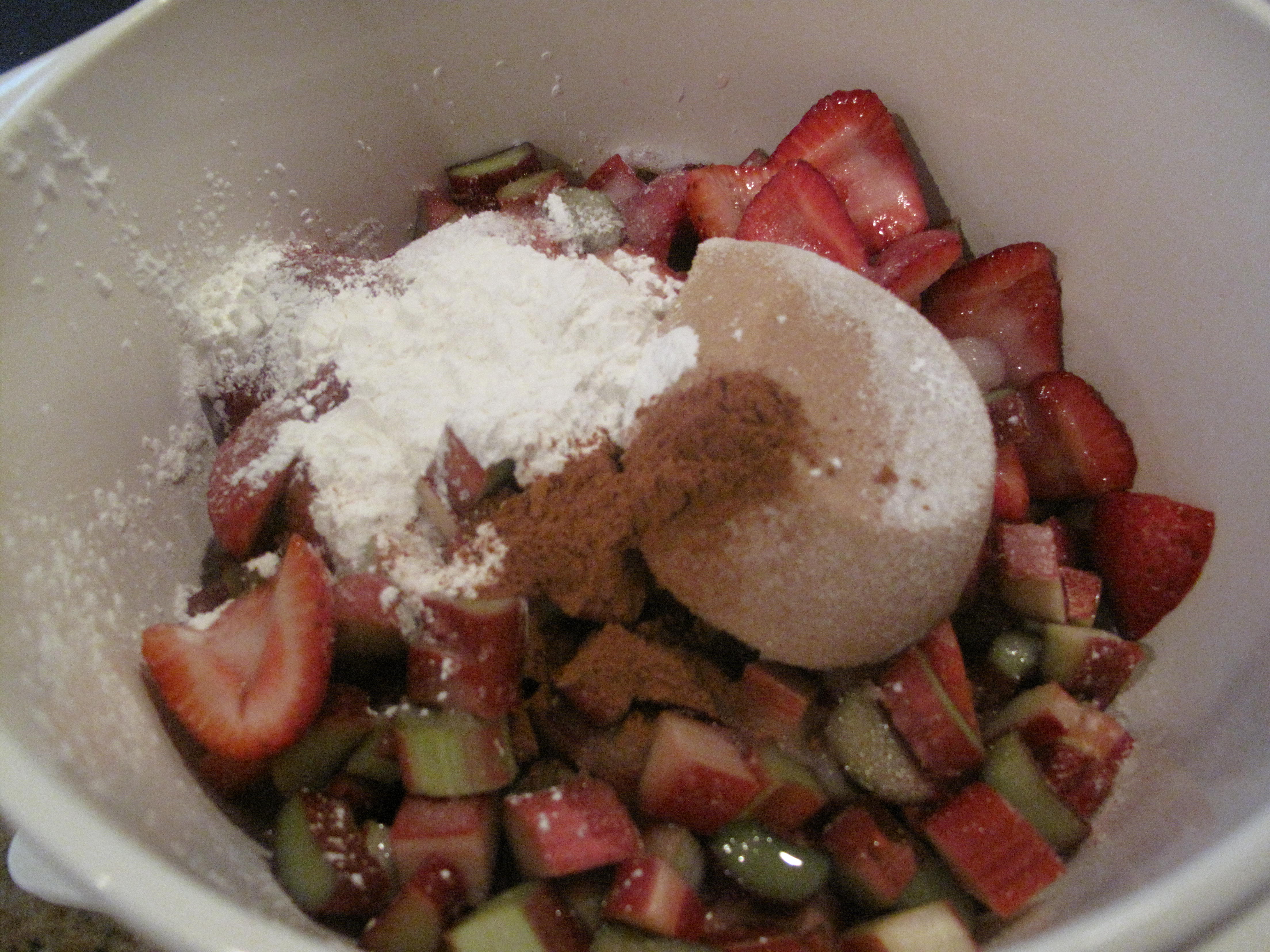
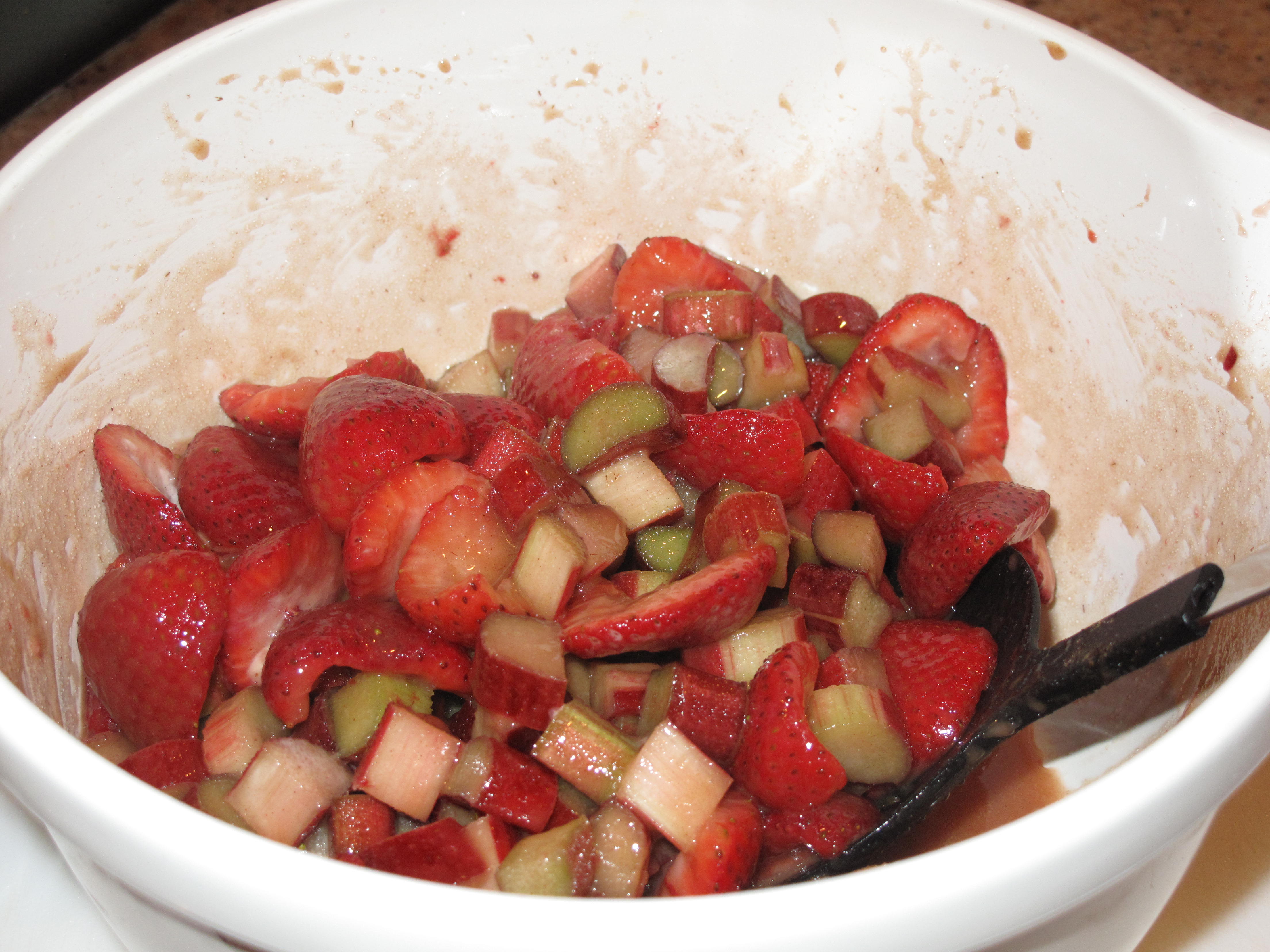
Make filling: Preheat oven to 400°F.  Combine first 7 ingredients into a large bowl.  Toss gently to blend.

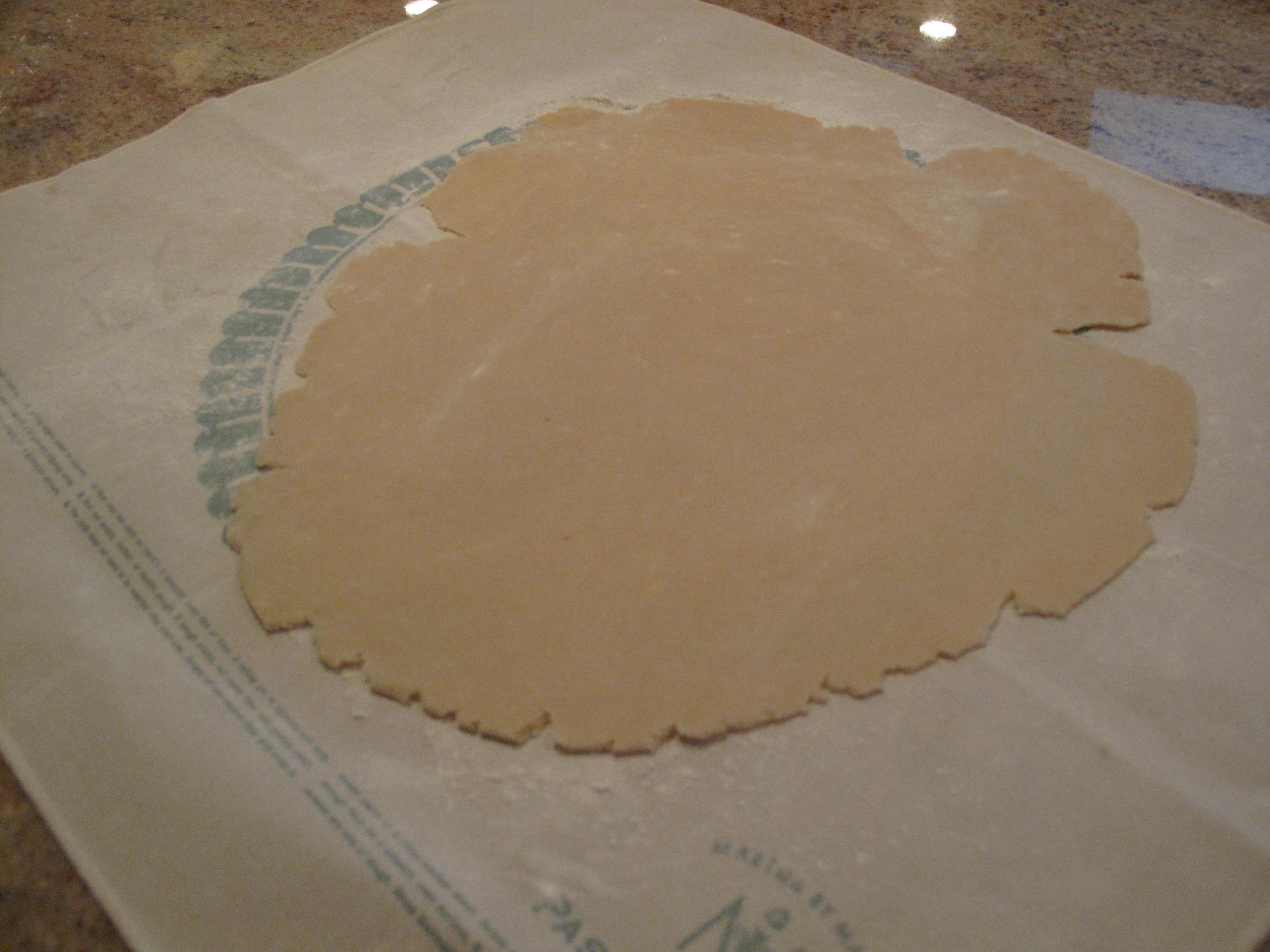
Assemble pie:  Roll out 1 dough disk on floured work surface into a 13-inch round.  Transfer to a 9-inch-diameter glass pie dish.  Trim excess dough, leaving a 3/4-inch overhang.  Place into refrigerator so the crust can continue to chill after being worked with in this step.  Chilled pie dough bakes the best.

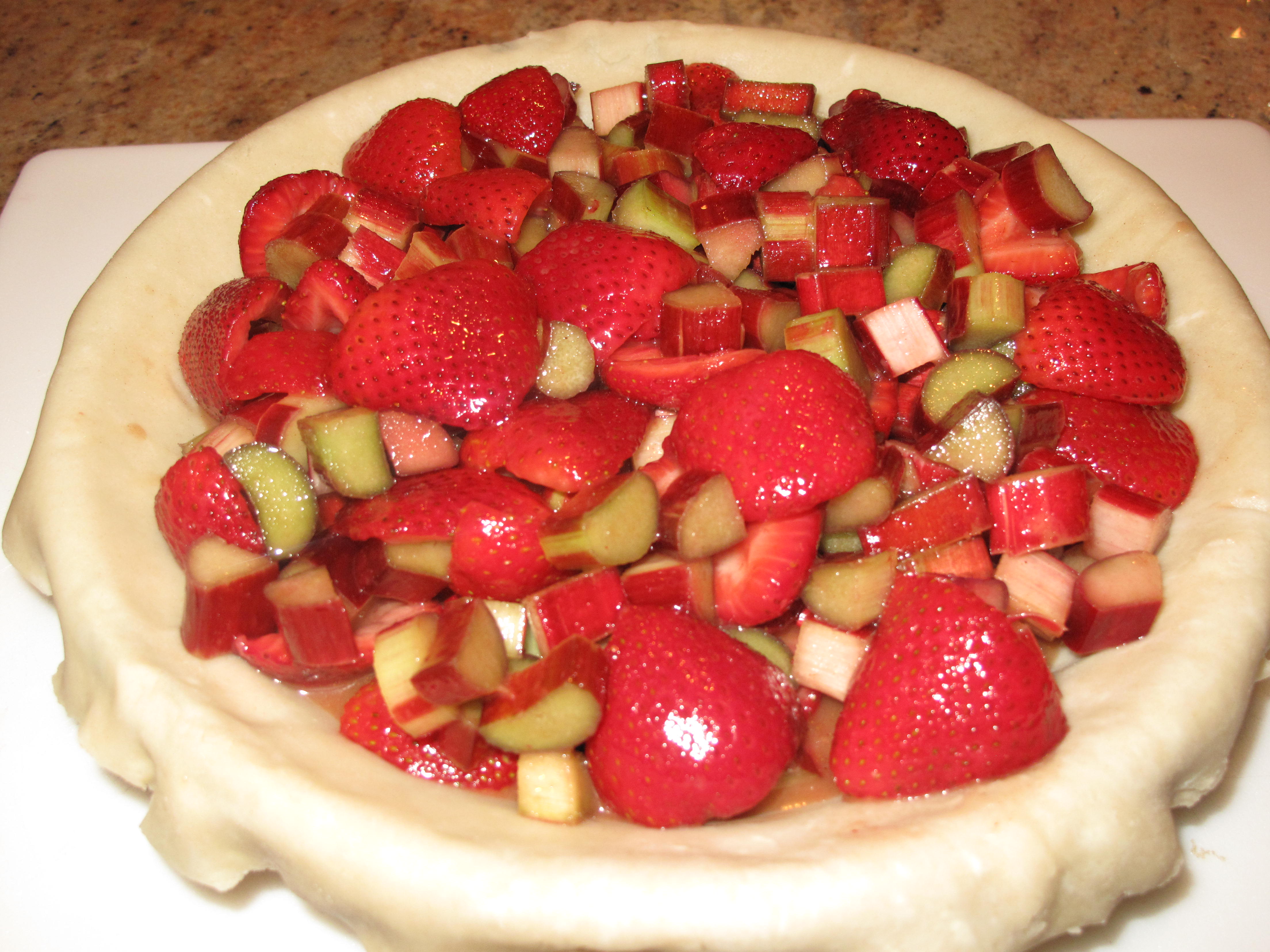
Roll out second dough disk on a lightly floured surface into another 13-inch round.  Cut into fourteen 1/2-inch-wide strips.  Spoon filling into crust.  Arrange 7 dough strips on top of filling, spacing evenly.  Form lattice by placing remaining dough strips in opposite direction on top of filling.  Trim ends of dough strips even with overhang of bottom crust.  Fold strip ends and overhang under, pressing to seal.  Crimp edges decoratively.  Brush glaze over crust.  Place pie back into refrigerator so that it can chill again for several minutes.  Chilled pie dough bakes the best.

Transfer pie to baking sheet.  Bake 25 minutes.  Reduce oven temperature to 350°F.   Bake pie until golden and filling thickens, about another 30-35 minutes.  Transfer pie to rack and cool completely.

During cooking, it is important to keep an eye on the pie and keep baking until the sauce in the pie gets thick (versus watery in form).  This may mean you will need to cover the edges of the crust with aluminum foil or a crust cover to prevent it from burning.  Once the sauce is thick, you know the pie is ready to take out of the oven.  The sauce will continue to thicken during the cooling process.  You can eat this pie plain or with a scoop of ice cream on top.  Eating something fresh and in season is the eighth wonder of the world.  This pie is the right pick for Spring.  I hope you like it.  What other Spring recipes are you cooking in your home?

Easter Bunny Martini

This is a martini recipe to help you celebrate Easter.  It also helps calm your nerves if you are cooking for a large group or if you are around family members that are annoying you.  Don’t let the look of the martini fool you.  While it looks like a creamy chocolate milkshake, there is enough vodka in it to make any Easter (or any day) a good one.  It was made by Jeff the Bartender at Toscana Restaurant in Ridgefield, CT, http://www.toscanaridgefield.com.  If you live in the area, go there for some great Italian food.  Here is the recipe:

Ingredients:

  •  1/3 combination of Absolut vodka and Absolut vanilla vodka
  • 1/3 Godiva chocolate liqueur
  • 1/3 dark creme de cacao
  • 1 small chocolate bunny (for garnish)

Directions:

Place ingredients into a martini shaker with ice.  Shake well with ice and strain into a chilled martini glass.  Using a small knife, make a slice upwards under the ribs of the chocolate bunny.  (Attention animal lovers:  this will not hurt the bunny).  Hook on the rim of the martini glass and drink.

Enjoy your bunny martini and have a Happy Easter…..if you can remember it after drinking this martini.  What holiday themed drinks do you make for your family and friends?

Friday Dance Party – Fergie Time

This is another edition of Friday Dance Party on Acorns On Glen.  It’s the time where we give thanks for making it through another week and for being able to celebrate this fact.  How do we celebrate another week of living?  We dance.  First off, Happy Earth Day, Happy Passover and Happy Easter to all of you.  We hope this important week in religion and with our planet finds you and your families safe and sound.  So, are you alive this Friday?  Are you and your family safe and sound?  Did you give thanks for that?

Good, now let’s dance.

I have been wondering how to celebrate the upcoming nuptials of Kate and William over in England.  Do I send them a blender or a food processor?  You know, a kitchen appliance wrapped up in a big box with a big, blue bow on it is every newly married couple’s dream gift.  Probably not, right?  How about I DVR the wedding and send over a DVD copy of the day to them so they always have it at their fingertips in case they want to watch?  Maybe.   How about Fergie singing ‘London Bridge’ to them in celebration of their wedding and their hometown?  Sounds perfect to me…that’s what I would want.  So here you go Kate and William, a tribute from Fergie.  I hope all of you will shake it to this tune for getting through another week.  I bet that in some back corner of Buckingham Palace, Kate and William are shaking it too.  Are you excited about the upcoming royal wedding? 

Cardinal Love Is A Battlefield

This is how we woke up this morning.  Through closed windows and with light rain falling, we woke up to the sound of super loud bird noises.  First, it was loud beautiful singing.  Next, shrill one-note warbles.  Then back to loud beautiful singing.  Where we live, you never know what you are going to find when you pull back the curtains to take a peek.  Today it was the sight of two male Cardinals fighting for the love of one female.  I thought the fight looked pretty intense so I crept outside to take some pictures.  I’m sure the Cardinals were also quite amazed at the sight of me running around in the rain in a t-shirt, pajama bottoms and no shoes trying to capture some pictures of their Spring love ritual.  This ritual consisted of the female enjoying front row seats and sitting there watching the mayhem.  All morning, one male would fly at the second male.  There would be an in-air or on-branch fight consisting of a flurry of wings and loud warbles.  Then one or the other male would fly off a few hundred feet away and rest and plot the next attack.  First, meet the female.  The object of their affection:

Here is the first male.  Notice how he is a little larger than the other male.  This helped him because, if I was the fight judge, this guy would have won.

Here’s the second male.  Slightly smaller, but he sure is scrappy.

As we left for work this morning, the fight was still raging.  I started to wonder what would happen to the loser.  Does he finish the summer a bachelor or does he go and find another female to marry?  While I think the larger male will win the love of the female, there was also a little piece of me that was rooting for the smaller guy.  I’ve always had a soft spot for an underdog.  While we don’t know the ultimate winner yet, I did find some interesting reading on Cardinal mating on the internet. 

Here is a piece from http://www.birdhouses101.com:

The early spring is the mating season for Cardinals.  These songbirds are known as “socially monogamous” but there are times when they copulate with the others.  There was even one study which found that nine to 35 percent of Cardinal nestlings came from extra-pair copulations.

The mating season begins with pair formation that includes different physical displays of cardinals.  The males show off to attract a female.  They also do the courtship and mate feeding.  Females choose their mates based on the male’s ornamentation such as the size of his black face mask as well as the color of his plumage and bill.  Studies have found that the ornaments of male and female Cardinals provide information on the bird’s condition.  For instance, females with a big face mask shows that they are good defenders of nests but for males, this means that they are not highly successful in reproduction.

Mate feeding occurs when the male Cardinal picks up a seed, hops near the female and the two touch beaks so the female can take the food.  Mate feeding will go on until the female lays eggs and incubates them.  Normally, pairs of Cardinals stay together throughout the year and may breed for several seasons.  This bird lives an average of one year although there have been records of longer life spans.

Did you know that Cardinals sing their best during the love season?  They sing with great emphasis as evident in the swelling of their throat, spreading of their tail, drooping of wings and leaning from side to side as if performing on stage with much gusto.  They repeat these melodies over and over again resting only for a short time to breathe.

This slideshow requires JavaScript.

Who knew we would use words like ‘copulate’ and ‘extra-pair copulation’ here on Acorns On Glen?  All in all, the Cardinal love story was and probably will keep being a great show here on Glen Road.  Nature always proves to be a great theatre if you pay attention to it.  I’m glad we have Cardinals in our backyard and that we took the time to notice them.  What other strange Spring mating rituals are going on in your neck of the woods? 

Never Met Bread That I Didn’t Like

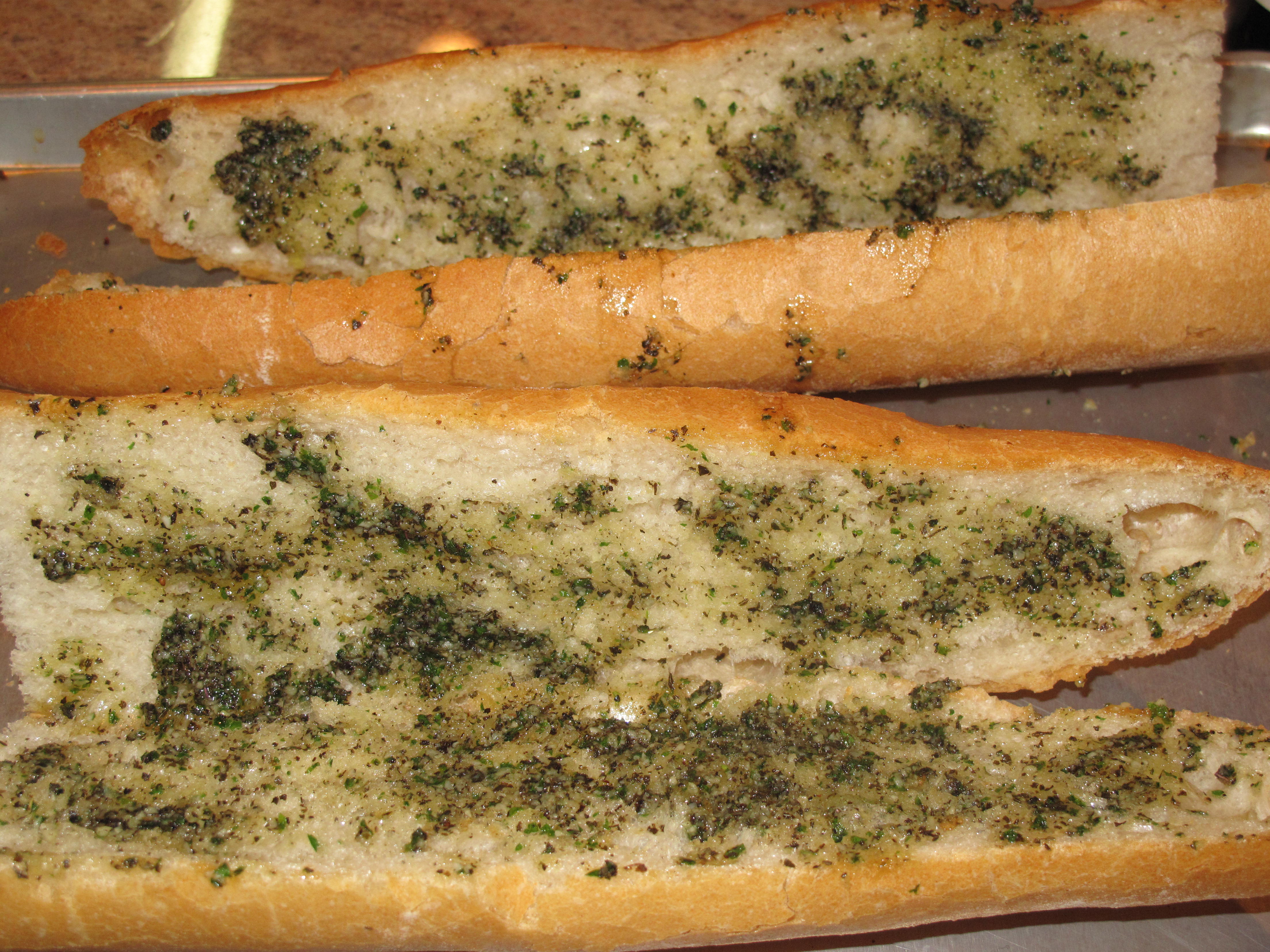
This is a quick recipe.  We eat a ton of Italian food here on Glen Road (have you noticed?).  What goes better with Italian food than garlic laced, herbed bread?  Nothing, trust me, nothing.  I have never met bread that I didn’t like.  Give this garlic herbed bread a try one night at dinner.  You and your family will love it. 

Ingredients:

  • 6 large garlic cloves, chopped
  • 1/4 cup flat-leaf parsley
  • 1 tablespoon fresh chopped basil leaves
  • 1 teaspoon kosher salt
  • 1/2 teaspoon freshly ground black pepper
  • 1/2 cup good olive oil
  • 1 large baguette

Directions:

Preheat the oven to 350 degrees.

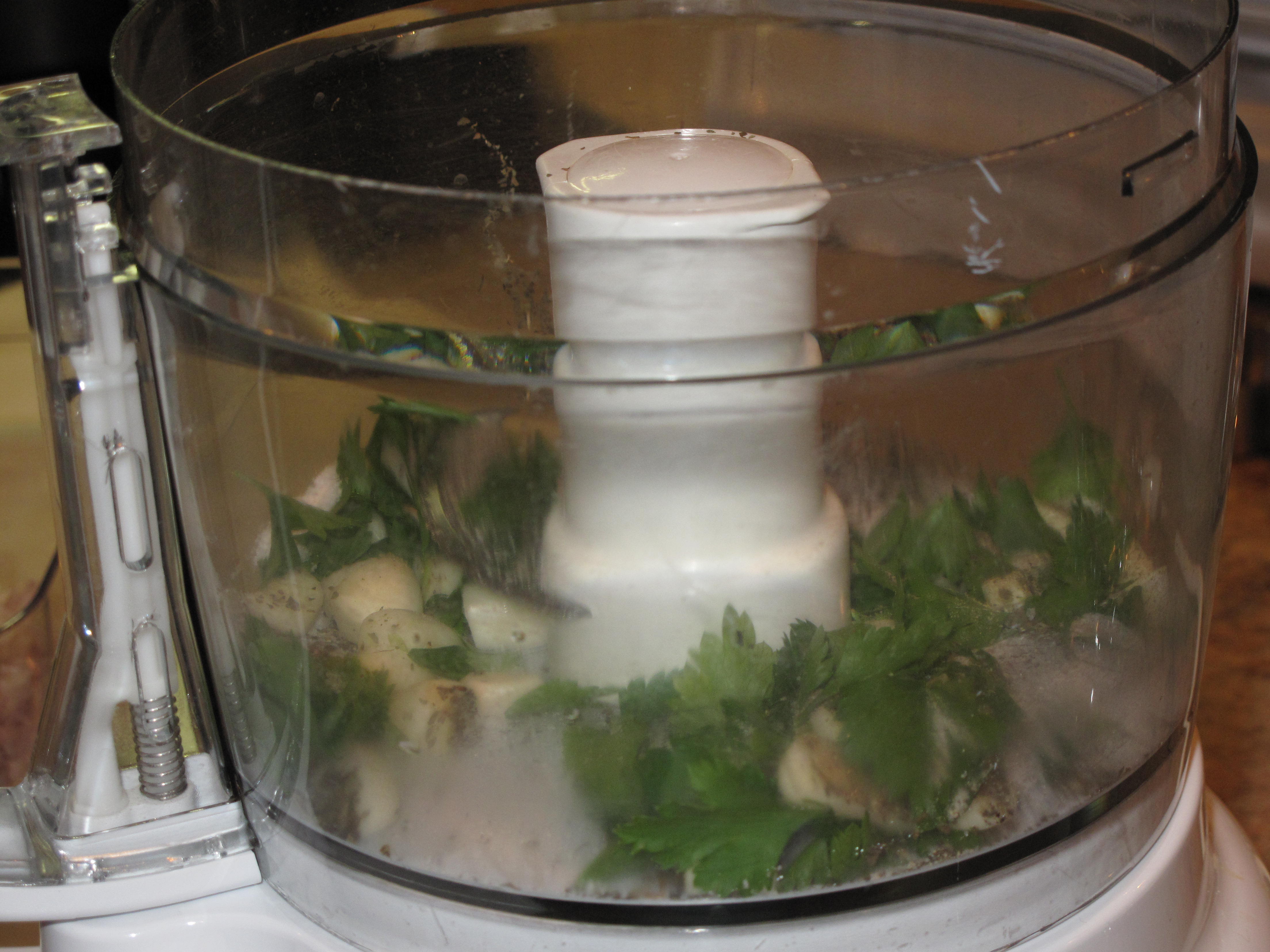
Place the garlic, parsley, basil, salt and pepper in the bowl of a food processor fitted with the steel blade and process until finely minced.

Heat the olive oil in a medium saute pan over medium heat.  Add the garlic and parsley mixture and cook for 1 minute, until the garlic is tender but not browned.  Remove from the heat and set aside.

Slice the baguette lengthwise down the center, but not all the way through, and spoon the garlic mixture into the bread.  Place the bread on a sheet pan and bake for 8 minutes.  Slice diagonally and serve warm.

Super quick and super easy.  The kind of recipe that I like.  If you are in a pinch, I’ve also used dried parsley and basil flakes when I didn’t have fresh herbs on hand.  It won’t yield the same flavor intensity as using fresh herbs, but it does come out very tasty.  Give this bread a try and let us know how you liked it.  What other bread recipes do you have that you can share on Acorns On Glen?

The Brooklyn Italian Grandmother Is Back And Cooking

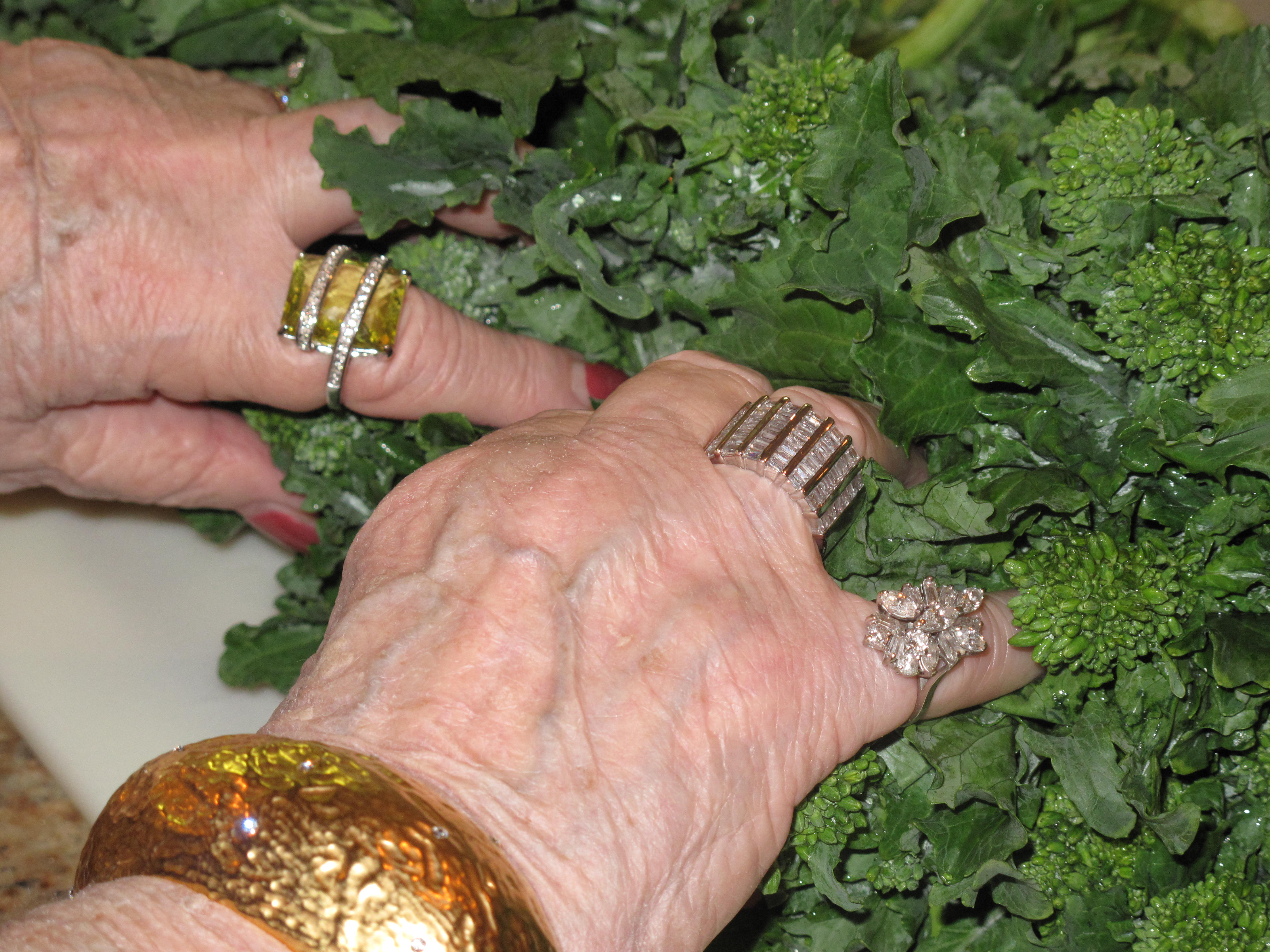
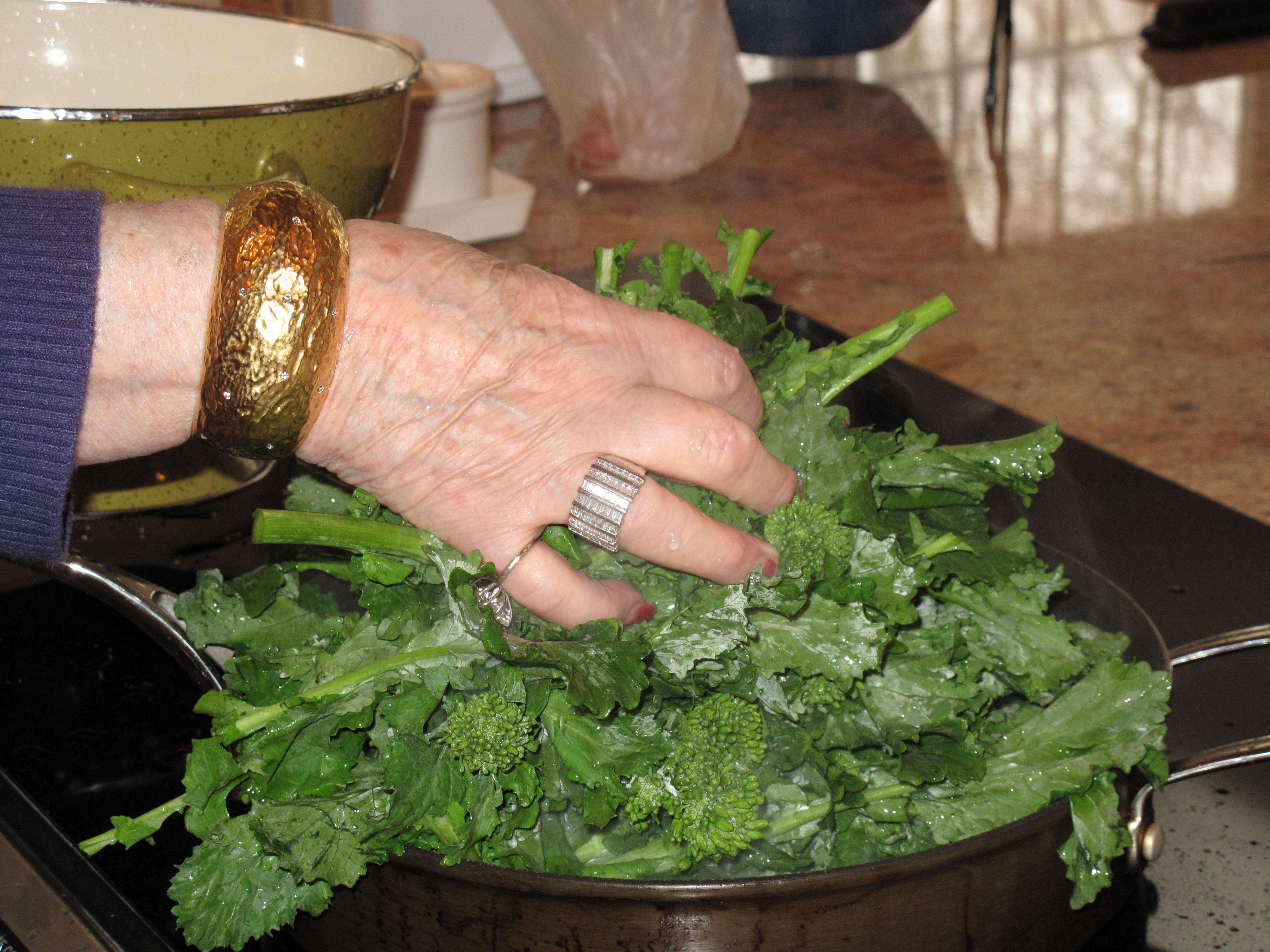
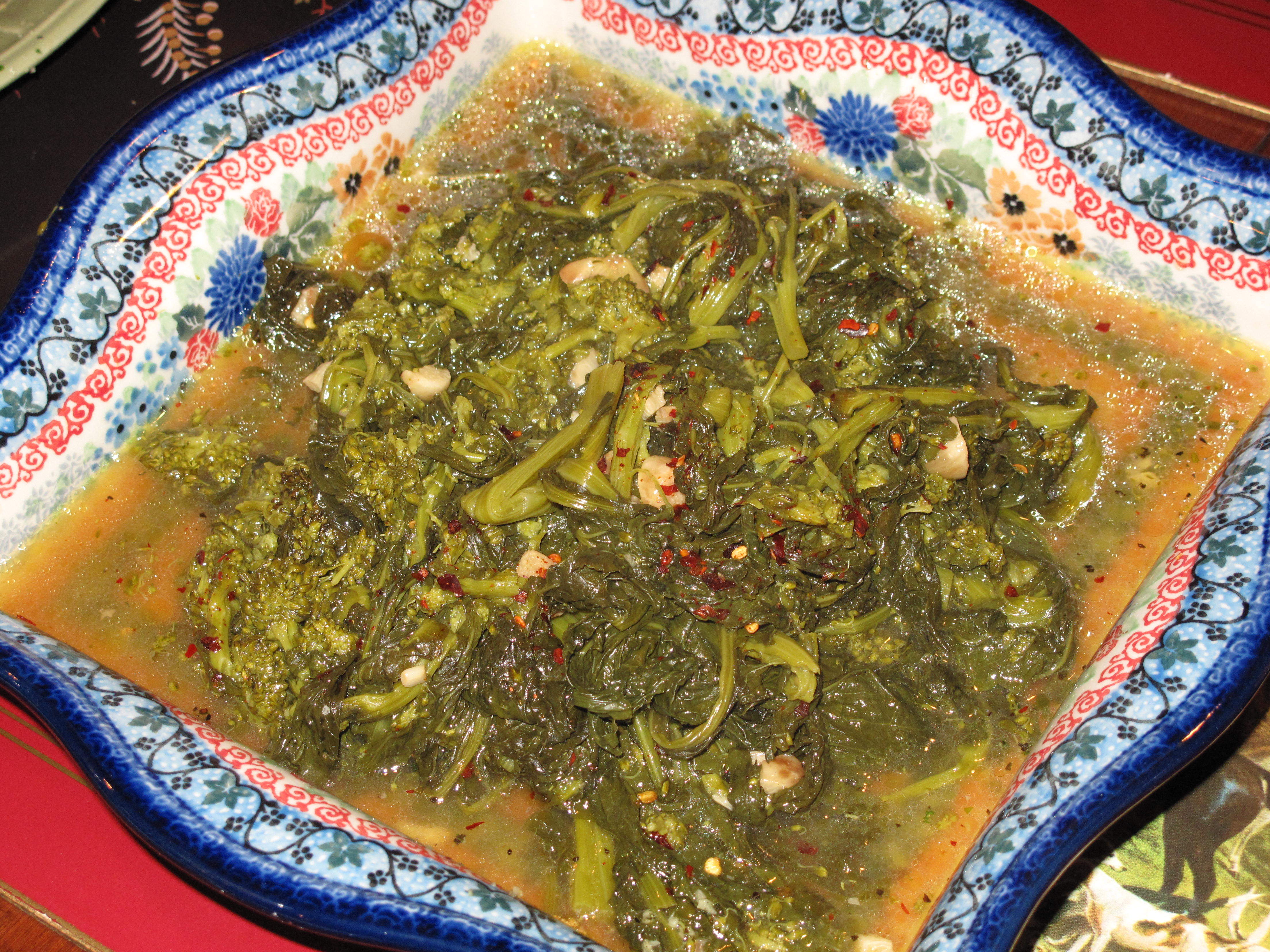
This is our Brooklyn Italian Grandmother back in the kitchen and digging into a pile of broccoli rabe.  Otherwise known as cooking with your fingers only up to the base of your rings.  We can dig that, can you?  What has happened to the world of broccoli rabe these days?  They steam it….good for you.  Yuch, it is tasteless!  They stir fry it.  O.K., but limp and mushy.  They saute it in water.  That’s called boiling it where we come from.  We asked our Brooklyn Italian Grandmother to come back into the kitchen and make it the good old-fashioned way so that we could share it with everyone.  This is a great side dish and is quick and easy.  When you are making an Italian dish, cook up some broccoli rabe and see what the family says.  While many people say it has a bitter taste, we have found that if you cook it up the Brooklyn way, the rabe is soft and delicious.  I’ve held the Brooklyn Italian Grandmother down and measured and forced her to tell me her recipe.   So let’s take what I’ve forced out of her and cook up some broccoli rabe and go jewelry shopping all in one post.

Ingredients:

  • 2 large heads of broccoli rabe.  I found organic and super fresh.  We beg you to do the same.  Your body doesn’t need the chemicals. 
  • 3 tablespoons great olive oil
  • 7 cloves of garlic, roughly chopped.  More or less depending on how much you love garlic.  We adore it so use 7 cloves if you are truly a garlic lover.
  • 1 cup chicken stock, again go organic if you can
  • 1 chicken bouillon cube
  • 1 1/2 teaspoon of kosher salt, or more to flavor to your liking
  • 1/2 teaspoon of freshly ground black pepper or more to your liking
  • 1/2 teaspoon red pepper flakes or more/less to taste.  We like it spicy.

Directions:

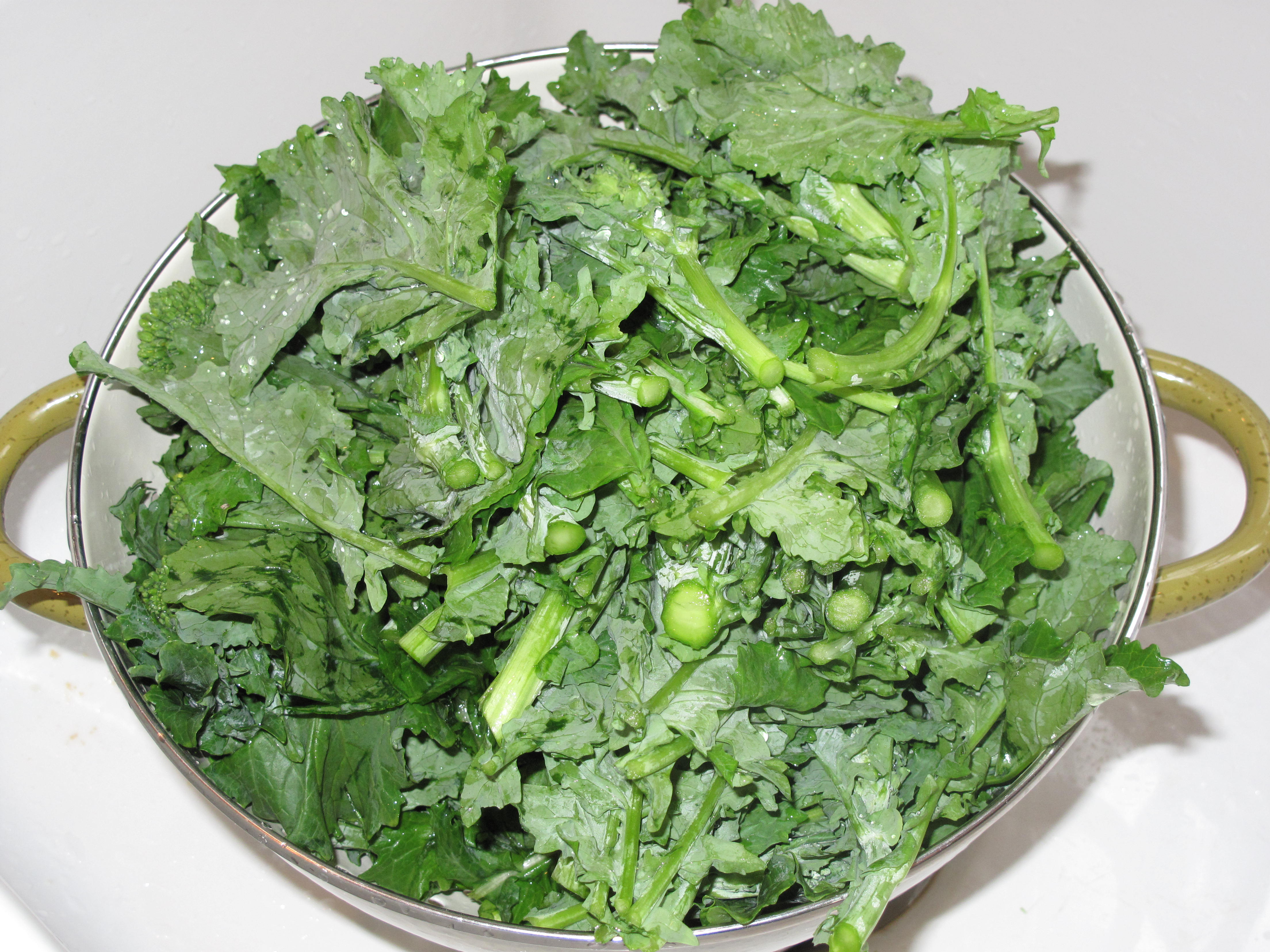
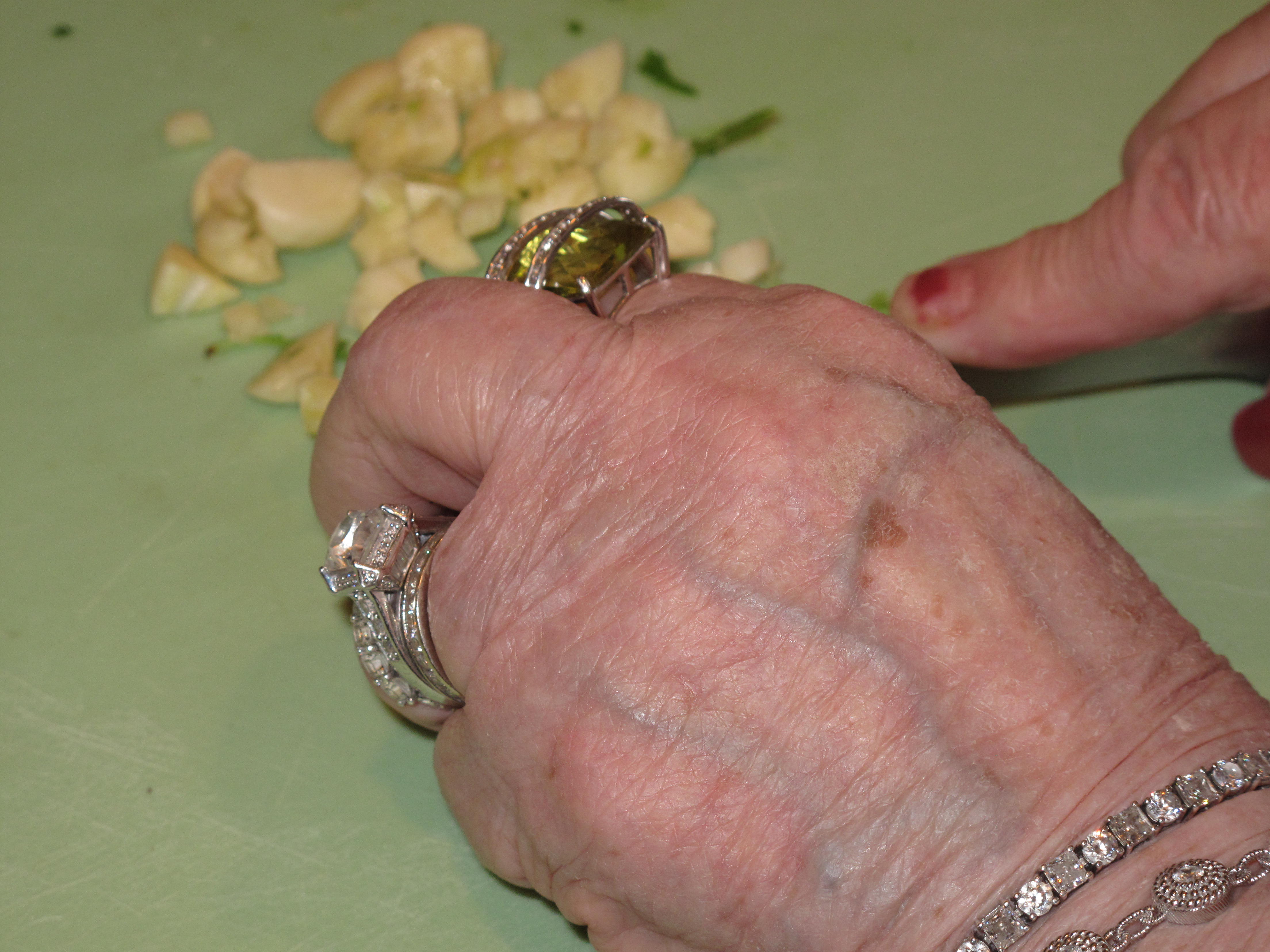
Trim the stalks of the brocolli rabe and rinse under cool water.  Roughly chop garlic cloves.

  Rings always look better with a garlic scent to them.  Multiple bracelets support the wrist during the chopping process.

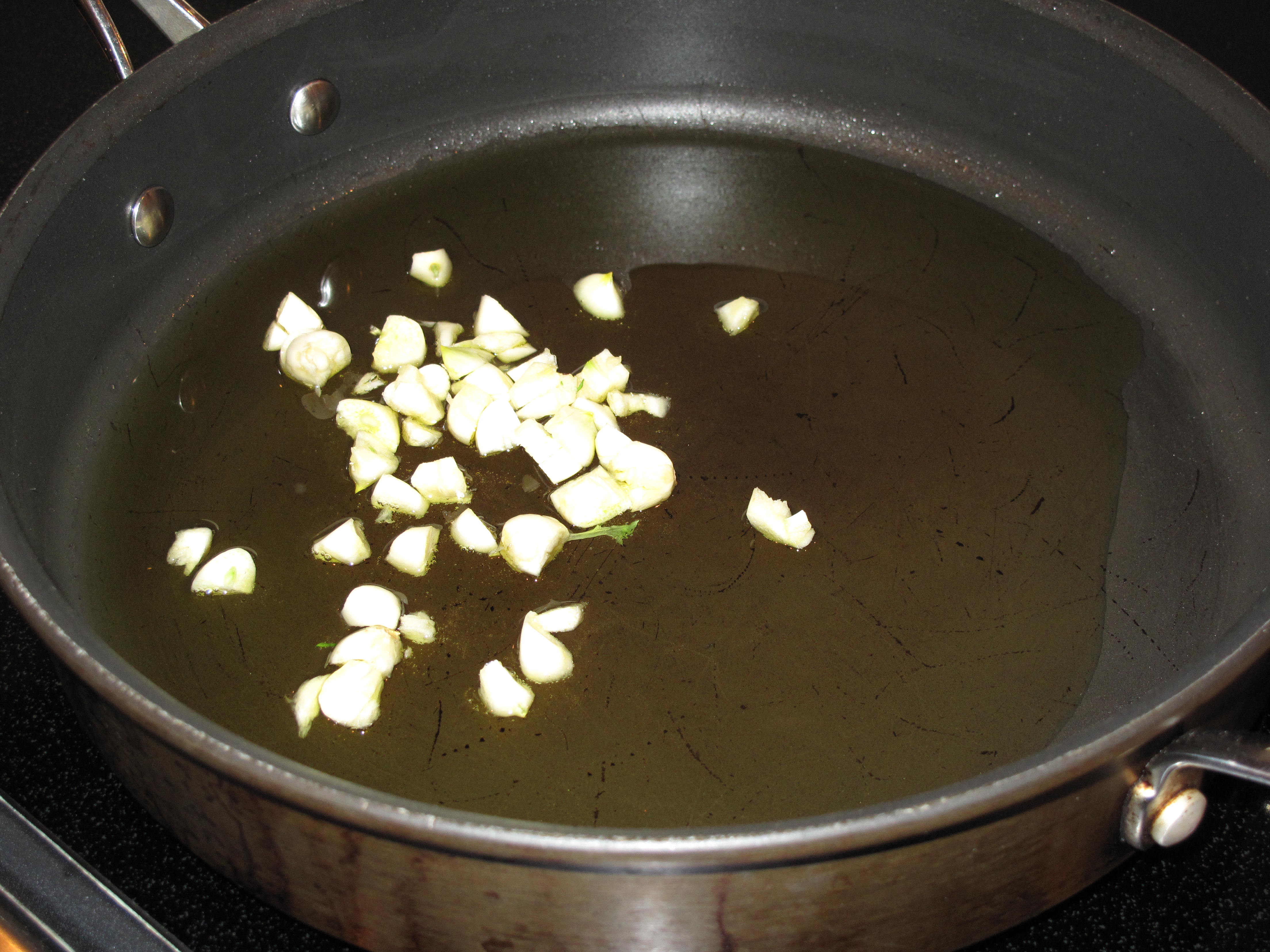
Over medium heat, heat the olive oil and then add the chopped garlic and sautee until garlic is lightly golden in color.

Add the chicken broth and the chicken bouillon cube until they are lightly heated.  Then add the cleaned and rinsed broccoli rabe.  Don’t be nervous if the rabe is stacked high in the skillet.  It will quickly wilt down to a reasonable amount.

  What takes away from beautiful green, organic and fresh rabes more than diamonds and solid gold?

Lightly place a skillet lid on top of the broccoli rabe and continue to adjust it while the rabe wilts down.

  Lid protects jewels from damage but also allows steam to lightly clean the gems.  We call this multi-tasking.

As the broccoli rabe wilts down during the cooking process, raise the lid and add a teaspoon of salt to flavor during cooking.  Place the lid back on the rabes and saute for about 10 minutes.  Lift lid and turn over the broccoli rabe so the bottom is now on the top and place the lid back on for another 10 minutes.  Continue cooking until rabes are al dente, meaning tender but they still possess a little chewiness to them.

   Diamonds are forever….sing it.

When tender, add another half a teaspoon of salt and the pepper or more to flavor the broccoli rabe to your liking.  Add the red pepper flakes to add a little heat.  If you like it hot, add more.  If you can’t take the heat, don’t add any red pepper flakes.  Use your own judgement. 

Come on…have you ever seen such a beautiful and exotic side dish to complement your favorite Italian dish?  Broccoli rabe is not for everyone, but it is for most people that we have served it to in the traditional Brooklyn Italian Grandmother way.  Who needs to light up their life when you can rabe up your life?  Just a little hint–some great bread is delicious when you use it to dip in and soak up the broth from the rabes.  And remember, it also is a great way to clean your jewelry in an organic sort of way.  Give it a try….you won’t be sorry.  What side dishes can you share on Acorns On Glen that would be great with Italian food?